


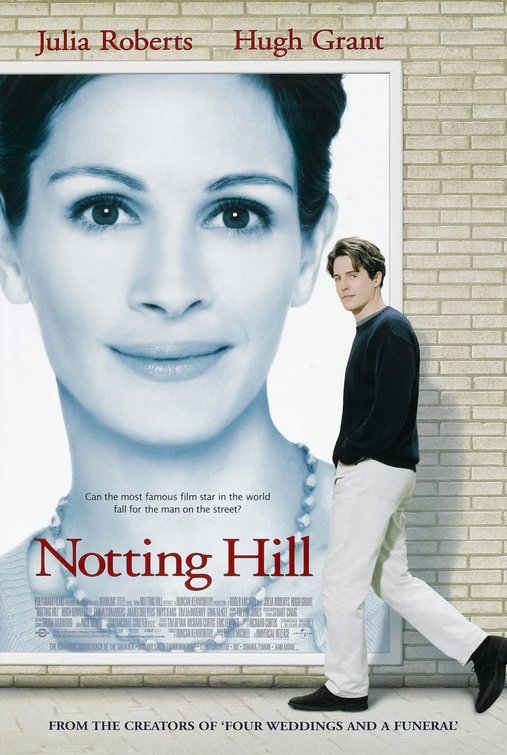
Notting Hill
Released in 1999 by Working title and Polygram Filmed entertainment, Notting hill became a worldwide success and one of the best loved Romantic Comedies in recent times. it's worldwide box office coming in at around $247 million.
The Opening Sequence
 The first thing the audience sees is a black screen with the name of the production company 'Polygram Filmed entertainment' written in pink and white font, accompanied by the diegetic sound of a news report.

The pink and white font is maintained throughout the names of the companies involved.
The news report recording fades and is replaced by a slow piano based song.


A similar sequence then occurs with the male lead, with him narrating during several shots which dissolve into one another. A crane shot is used to show the busy London street and show a stark contrast between the two main character's lives. The shots track the male character but often from a distance which again contrast with the often extreme close ups of the female lead. The credits, maintaining the same font throughout, are now written in just white. They end with 'directed by...' as is convention.
The Opening Sequence


The pink and white font is maintained throughout the names of the companies involved.
The news report recording fades and is replaced by a slow piano based song.


The sequence then cuts to a montage of clips establishing the main character, most of the clips dissolve into the next one as if to show the passage of time, however there are also two graphic matches to show the female lead on magazine covers. The slow song is maintained through out the opening montage. The credits for the main actors are written in different colours but are linked through the use of the main font.


A similar sequence then occurs with the male lead, with him narrating during several shots which dissolve into one another. A crane shot is used to show the busy London street and show a stark contrast between the two main character's lives. The shots track the male character but often from a distance which again contrast with the often extreme close ups of the female lead. The credits, maintaining the same font throughout, are now written in just white. They end with 'directed by...' as is convention.
 10 things I hate about you
Released in 1999 by Touchstone pictures, and inspired by Shakespeare's 'taming of the shrew'. A slightly more edgy rom-com, with a strong leading female main character.
The Opening Sequence
Begins with 'Touchstone Pictures' logo. Accompanied by the electric guitar intro for a song. There is then a crane shot to establish the setting as Seattle, Washington. The music becomes diegetic as we pan across to see girls listening to the song in their car in the middle third of the screen.
Another song then takes over the sound and the camera pans across to see the female protagonist in her car. The first line of the song 'I don't give a damn about my reputation' can be heard clearly and suits the costume and overall tone of the character.
There is a reaction shot of the girls in the blue car and their expressions establish to the audience the comedy element of this rom-com.
Another crane shot is used to again establish the setting, this time of an american high school, followed by a tracking shot of the female lead.
A comical element is apparent throughout as later on there is a very long-take tracking shot of a new student being shown round school, lots of 'groups' are shown with the mise-en-scene connoting their different cliques and interests. The music during this shot is an repeated drum and guitar track, the music is combined with the diegetic dialogue and ambient murmurs of the people around which is kept low in the mix.
Another song then takes over the sound and the camera pans across to see the female protagonist in her car. The first line of the song 'I don't give a damn about my reputation' can be heard clearly and suits the costume and overall tone of the character.
There is a reaction shot of the girls in the blue car and their expressions establish to the audience the comedy element of this rom-com.
Another crane shot is used to again establish the setting, this time of an american high school, followed by a tracking shot of the female lead.
A comical element is apparent throughout as later on there is a very long-take tracking shot of a new student being shown round school, lots of 'groups' are shown with the mise-en-scene connoting their different cliques and interests. The music during this shot is an repeated drum and guitar track, the music is combined with the diegetic dialogue and ambient murmurs of the people around which is kept low in the mix.
The credits throughout are in the same stylised font, ranging in different colours for different names. The title of the film '10 things I hate about you' appears first and the names of the principal actors/actresses follow. The credits continue for an unusually long time, only ending around the 4 min 30 secs mark. The last name given is of the director 'Gil Junger', as is convention.
Order of Credits
A general order of the credits is as follows...
PRODUCTION COMPANY(S)
"TITLE"
Lead Cast
Supporting Cast
Casting Director
Music Composer
Costume Designer
Associate Producers
Editor(s)
Production Designer
Director of Photography
Executive Producer
Producer
Writer(s)
Director
Exceptions to this are the placing of the Title of the film and (if he or she is well known) the placing of the director's name.

No comments:
Post a Comment